Best Internet Speed for Online Gaming 2026
HighSpeedOptions prides itself on providing honest, quality content. While we may be compensated when you make a purchase through links on our site, all opinions are our own. Here's how we make money.
Table of Contents
What Are the Minimum Internet Speeds for Online Gaming?
Short answer: Minimum speeds for online play:5 Mbps download and 1 Mbps upload. But as always, there are a few key considerations to determine the best internet speed for gaming, as many factors erode your internet speed and connectivity. To maximize your gaming experience, follow along to learn about the best internet speed for gaming and what is sometimes more important than speed alone.
Key Takeaways: Best Internet Speed for Gaming
- Minimum speeds: At least 5 Mbps download and 1 Mbps upload are needed for online play.
- Latency matters most: Aim for 50 ms ping or less for smooth, responsive gameplay.
- Genre differences: Fast-paced shooters and battle royales demand higher speeds and lower latency than slower-paced RPGs or strategy games.
- Cloud gaming needs more: Services like GeForce NOW and Xbox Cloud require 10–20 Mbps download with stable, consistent bandwidth.
- Household impact: Budget about 25 Mbps per person in multi-user homes, and enable QoS to prioritize gaming traffic.
- Best connections: Fiber is ideal for low latency, while 5G home internet is improving but can be variable. Satellite works in rural areas but has very high latency.
- Other factors: Watch out for packet loss and jitter—even at high speeds, they can ruin your experience.
- Optimization tips: Use Ethernet, optimize router placement/settings, minimize network congestion, and test speeds regularly.
Factors That Affect Online Gaming Speeds
While the minimum speed requirements for online gaming are relatively low, several factors can reduce the speed of your internet connection. Consider the following to help determine the ideal speed for your gaming needs:
Shared Internet Connection
Are there other people and multiple devices that connect to the internet in your house? More connections cause network congestion, which slows down your overall speed. As a rule of thumb, budget about 25 Mbps per person in a multi-user household; more if others are streaming 4K or video conferencing. To find an internet plan tailored to your lifestyle, take this quick quiz to determine your internet speed requirements.
If multiple people in your home are online, look for a router with Quality of Service (QoS) settings. QoS lets you prioritize gaming traffic over other activities like streaming or file downloads, helping reduce lag when bandwidth is being shared.
Geographic Location and Internet Access
If you need internet in a rural or remote area where traditional broadband may be unreliable or unavailable, Starlink is a good option. Its high-speed satellite service delivers enough bandwidth for gaming, streaming, and everyday online activities, but latency is typically higher than cable or fiber.
Gaming Video Resolution
Your in-game resolution directly affects how much bandwidth your connection needs for smooth gameplay. Higher resolutions mean more data is being processed and transmitted per frame, which increases the demand on your download connection. This is amplified in fast-moving, visually dense games.
For most online games, resolution doesn’t dramatically spike bandwidth the way 4K video streaming does, because games transmit game state data rather than raw video frames. But resolution still matters in two important ways: it increases the load on your local network and significantly affects cloud gaming performance, since cloud gaming streams video frames to your screen.
Use these recommended minimums as a baseline for your connection:
| Resolution | Minimum Download | Minimum Upload |
| HD (720p) | 3 Mbps | 1 Mbps |
| Full HD (1080p) | 5 Mbps | 1 Mbps |
| 4K (2160p) | 25 Mbps | 5 Mbps |
Cloud gaming is the exception. If you’re playing via a service like GeForce NOW or Xbox Cloud Gaming, your device receives a live video stream of the game at your chosen resolution, rather than running it locally. At 4K, cloud gaming can require 35–40 Mbps or more for smooth, artifact-free video. At 1080p/60fps, NVIDIA recommends at least 15 Mbps.
Resolution affects download size, too. Games and texture packs are significantly larger at higher resolutions. A 4K texture pack for a modern title can add 20–50 GB to an already huge download.
Your monitor or TV sets the ceiling. If you’re gaming at 1080p, there’s no bandwidth benefit to running a higher resolution since your display can’t render it anyway. Match your resolution setting to your actual display output.
| Resolution | HD (720p) |
| Minimum Download | 3 Mbps |
| Minimum Upload | 1 Mbps |
| Resolution | Full HD (1080p) |
| Minimum Download | 5 Mbps |
| Minimum Upload | 1 Mbps |
| Resolution | 4K (2160p) |
| Minimum Download | 25 Mbps |
| Minimum Upload | 5 Mbps |
For most console and PC gamers playing at 1080p over a shared home connection, 25 Mbps download speed is a comfortable target that supports gameplay, voice chat, and background activity without causing congestion.
Downloading Games
A fast internet connection doesn’t just improve how you play online; it also determines how long you wait before you can play at all. Modern games are enormous, and slow download speeds can mean waiting hours or even overnight for a new title, patch, or expansion to finish installing.
The average game download size has grown to roughly 80 GB, with many titles between 100–150 GB, not to mention updates, DLC, and high-res texture packs. Call of Duty titles, for example, have exceeded 200 GB with all content installed. Even a “small” patch can be 5–20 GB.
How Download Speed Translates to Wait Time
Here’s a practical look at how your connection speed affects download times for a 100 GB game:
| Download Speed | Time to Download 100 GB |
| 10 Mbps | 22 hours |
| 25 Mbps | 9 hours |
| 50 Mbps | 4.5 hours |
| 100 Mbps | 2.25 hours |
| 200 Mbps | 1.1 hours |
| 500 Mbps | 27 minutes |
| 1 Gbps | 14 minutes |
| Download Speed | 10 Mbps |
| Time to Download 100 GB | 22 hours |
| Download Speed | 25 Mbps |
| Time to Download 100 GB | 9 hours |
| Download Speed | 50 Mbps |
| Time to Download 100 GB | 4.5 hours |
| Download Speed | 100 Mbps |
| Time to Download 100 GB | 2.25 hours |
| Download Speed | 200 Mbps |
| Time to Download 100 GB | 1.1 hours |
| Download Speed | 500 Mbps |
| Time to Download 100 GB | 27 minutes |
| Download Speed | 1 Gbps |
| Time to Download 100 GB | 14 minutes |
Tips to Speed Up Game Downloads
Even on a mid-tier plan, you can reduce download times with these small changes:
- Schedule downloads overnight or during off-peak hours. Most consoles and PC platforms (Steam, Xbox, PlayStation) allow you to schedule or queue downloads. Network congestion is typically lowest between 2–8 AM.
- Use a wired Ethernet connection. Wi-Fi introduces overhead and instability that can slow large downloads by 20–40% compared to a direct wired connection, even at the same plan speed.
- Pause other network activity. Streaming, video calls, and other devices actively uploading or downloading will compete for bandwidth and slow your game download.
- Enable console-specific download settings. On PlayStation 5, enabling “Rest Mode downloads” allows the console to download in the background at full speed without competing with active use. Xbox Series X has a similar “Instant-On” feature.
- Check your router’s QoS settings. Some routers let you prioritize download traffic to specific devices, which can help when others in your household are using the network simultaneously.
If game downloads are consistently slow despite a fast plan, the bottleneck may be the game publisher’s servers rather than your home connection, especially on major launch days when millions of players are downloading simultaneously. Waiting 24–48 hours after a major release often results in significantly faster download speeds.
Live Streaming and Gaming
Beyond downloads, how you use your connection—like streaming gameplay—also impacts speed needs. Streaming your gameplay (Twitch/YouTube) leans heavily on upload speed. Aim for at least twice the minimum—especially if you want smooth 1080p video and voice chat.
Game Servers vs. Home Internet Connection Issues
Before troubleshooting your home network, make sure the problem isn’t on the game’s side. Many connection issues that feel like a bad internet connection (lag spikes, disconnects, matchmaking failures) may come from server outages, maintenance, or service disruptions.
Identifying Server-Side Problems
Common Indicators of Server-Side Issues
- Widespread reports at the same time: If many players are reporting the same problem, it often points to a server or platform issue rather than your home network.
- Official service status alerts: Many publishers and platforms provide status pages or live service updates (for example, Epic Games Public Status, PSN Status, Riot Service Status, Xbox Status, and World of Warcraft realm status).
- Support and community updates: Some game devs may post issue updates in official support hubs, blogs, or community channels (for example, Rocket League’s support page links to status, known issues, and social updates).
How to Check if a Game’s Servers Are Down or Experiencing Problems
- Official status page: Check the game or platform’s official status page for outages, maintenance, or degraded services. Epic explicitly directs players to its public status page to confirm outages and maintenance windows.
- Official support/community channels: Check the game’s support site, known issues pages, or official community channels and forums for live updates and workarounds.
- Third-party outage trackers: Tools like DownDetector can help confirm whether lots of users are reporting problems at the same time.
Diagnosing Home Internet Problems
How to Determine if the Issue Is with Your Home Network
- Run built-in connection tests: Use your console’s network test tools (and similar diagnostics on PC) to check connectivity. Nintendo and PlayStation both provide built-in steps for testing internet connections. Xbox’s console speed test also reports details like latency, packet loss, and upload and download speeds.
- Run a speed test: Check your actual speeds (and ideally ping/latency) to see whether your connection is performing as expected.
- Check other devices or games: If only one game is acting up, it may be a game or server issue; if multiple devices or services are struggling, the issue is more likely on your home network or an issue with your internet provider.
Common Home Network Problems and How to Fix Them
- Restart your router and modem: Power cycling your network devices can resolve temporary connection issues.
- Update router firmware: Firmware updates can improve reliability, features, and security.
- Reduce Wi-Fi interference: Place your router in a central, elevated location, away from interference sources such as microwaves and cordless phones.
- Upgrade hardware or use Ethernet: If Wi-Fi is inconsistent, upgrading your router, adding an extender or mesh network, or switching to a wired connection can improve stability.
Internet Latency and Online Gaming
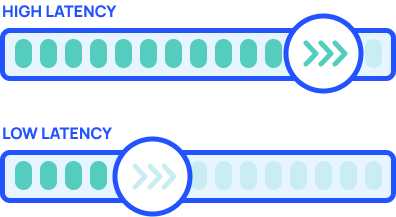
Latency—often called ping—matters more than raw speed. It’s the time (in milliseconds) for data to travel to the game server and back. Lower is always better:
- Under 20 ms is ideal for shooters
- Under 50 ms works for competitive games
- Under 100–150 ms is tolerable for slower genres
High ping usually comes from distance to the server, but congestion, server load, and poorly optimized apps can add delay, like rush-hour traffic on a highway.
Lower latency is more beneficial to online gaming than faster internet speed.
Beyond latency, gamers should watch out for packet loss (dropped data) and jitter (inconsistent ping). Even with fast speeds, these issues can cause lag spikes, rubber-banding (player movement snaps backwards and forwards), or disconnects that ruin gameplay. Tools like TestMySpeed.com can help you measure packet loss and jitter to ensure a stable connection.
Tips to Lower Your Latency for Gaming
If you want to boost your gameplay, follow these tips to lower your latency.
- Use Ethernet. A wired connection is the quickest win for stable latency.
- Optimize Wi-Fi. If you must use Wi-Fi, place the router centrally and elevated, update firmware, and prefer 5 GHz.
- Reduce background load. Pause updates and close bandwidth-heavy apps; disconnect idle devices.
- Pick closer servers. Choose servers near your location and avoid high-traffic ones.
Test Your Internet Speed
Now that you know the minimum speeds required for online gaming, try running an internet speed test to see how your connection performs. Check your download speed, upload speed, and latency to make sure you’re getting the performance you need. Check out our speed test results resource to better understand your results. If you’re not, then it might be time to find better internet in your area.
Best Internet Connection Types for Online Gaming
Some types of internet are better than others for online gaming. Check out the table below of connection types ranked by speed and latency to find the ideal solution for your gaming needs.
| Type | Speeds | Avg. Latency | Providers |
| Fiber Internet | 500 – 5,000 Mbps | 10- 25 ms | EarthLink, Frontier |
| Cable Internet | 100 – 1,000 Mbps | 20 – 40 ms | Xfinity, Spectrum |
| DSL Internet | 25 – 150 Mbps | 30 – 50 ms | CenturyLink, Kinetic |
| Fixed Wireless Internet | 25 – 300 Mbps | 30 – 50 ms | Rise, Verizon |
| GEO Satellite Internet | 25 – 150 Mbps | 500 – 700 ms | Viasat, HughesNet |
| LEO Satellite Internet | 25 – 220 Mbps | 25 – 60 ms | Starlink, Amazon Leo |
| Type | Fiber Internet |
| Speeds | 500 – 5,000 Mbps |
| Avg. Latency | 10- 25 ms |
| Providers | EarthLink, Frontier |
| Type | Cable Internet |
| Speeds | 100 – 1,000 Mbps |
| Avg. Latency | 20 – 40 ms |
| Providers | Xfinity, Spectrum |
| Type | DSL Internet |
| Speeds | 25 – 150 Mbps |
| Avg. Latency | 30 – 50 ms |
| Providers | CenturyLink, Kinetic |
| Type | Fixed Wireless Internet |
| Speeds | 25 – 300 Mbps |
| Avg. Latency | 30 – 50 ms |
| Providers | Rise, Verizon |
| Type | GEO Satellite Internet |
| Speeds | 25 – 150 Mbps |
| Avg. Latency | 500 – 700 ms |
| Providers | Viasat, HughesNet |
| Type | LEO Satellite Internet |
| Speeds | 25 – 220 Mbps |
| Avg. Latency | 25 – 60 ms |
| Providers | Starlink, Amazon Leo |
Each type of internet connection brings its unique traits to your gaming experience. But for gamers, fiber internet is the best choice. Why fiber wins: low, consistent latency (often 10–25 ms) plus symmetric speeds. DSL can be workable, but latency rises with distance from the provider’s hub. Satellite offers coverage, but latency is typically much higher.
Minimum Internet Speed for Top Video Game Genres
We already know that action-packed first-person shooters and real-time strategy games need more bandwidth and low latency for quick data processing. This is especially true compared to more laid-back strategy or puzzle games, where split-second timing isn’t as crucial. Here is a look at the top online gaming genres and their minimum speed and latency requirements.
| Genre / Context | Minimum Download | Minimum Upload | Recommended Latency | Example Titles |
| FPS (First-Person Shooter) | 5 Mbps | 1 Mbps | < 50 ms (lower is better) | Halo Infinite, Call of Duty |
| RPG (Role-Playing Game) | 3 Mbps | 1 Mbps | < 100 ms | Diablo, Neverwinter, Baldur’s Gate |
| RTS (Real-Time Strategy) | 5 Mbps | 1 Mbps | < 100 ms | Company of Heroes, Warhammer |
| MOBA (Multiplayer Online Battle Arena) | 3 Mbps | 1 Mbps | < 60 ms | League of Legends, Smite |
| Battle Royale | 10 Mbps | 2 Mbps | < 40 ms | Fortnite, Apex Legends |
| MMORPG (Massively Multiplayer Online RPG) | 3 Mbps | 1 Mbps | < 150 ms | World of Warcraft, Final Fantasy XIV |
| Sports Games | 3 Mbps | 1 Mbps | < 100 ms | FIFA, NBA 2K26 |
| Cloud Gaming (e.g., GeForce NOW, Xbox Cloud)* | 10–20 Mbps | 5 Mbps | < 40 ms | Any AAA title via streaming |
| Competitive / Esports Play | 50–100 Mbps | 10 Mbps+ | < 20 ms | Valorant, Counter-Strike 2, Overwatch |
*Because cloud gaming streams video frames instead of processing them locally, it relies heavily on consistent bandwidth and low jitter.
| Genre / Context | FPS (First-Person Shooter) |
| Minimum Download | 5 Mbps |
| Minimum Upload | 1 Mbps |
| Recommended Latency | < 50 ms (lower is better) |
| Example Titles | Halo Infinite, Call of Duty |
| Genre / Context | RPG (Role-Playing Game) |
| Minimum Download | 3 Mbps |
| Minimum Upload | 1 Mbps |
| Recommended Latency | < 100 ms |
| Example Titles | Diablo, Neverwinter, Baldurâs Gate |
| Genre / Context | RTS (Real-Time Strategy) |
| Minimum Download | 5 Mbps |
| Minimum Upload | 1 Mbps |
| Recommended Latency | < 100 ms |
| Example Titles | Company of Heroes, Warhammer |
| Genre / Context | MOBA (Multiplayer Online Battle Arena) |
| Minimum Download | 3 Mbps |
| Minimum Upload | 1 Mbps |
| Recommended Latency | < 60 ms |
| Example Titles | League of Legends, Smite |
| Genre / Context | Battle Royale |
| Minimum Download | 10 Mbps |
| Minimum Upload | 2 Mbps |
| Recommended Latency | < 40 ms |
| Example Titles | Fortnite, Apex Legends |
| Genre / Context | MMORPG (Massively Multiplayer Online RPG) |
| Minimum Download | 3 Mbps |
| Minimum Upload | 1 Mbps |
| Recommended Latency | < 150 ms |
| Example Titles | World of Warcraft, Final Fantasy XIV |
| Genre / Context | Sports Games |
| Minimum Download | 3 Mbps |
| Minimum Upload | 1 Mbps |
| Recommended Latency | < 100 ms |
| Example Titles | FIFA, NBA 2K26 |
| Genre / Context | Cloud Gaming (e.g., GeForce NOW, Xbox Cloud)* |
| Minimum Download | 10â20 Mbps |
| Minimum Upload | 5 Mbps |
| Recommended Latency | < 40 ms |
| Example Titles | Any AAA title via streaming |
| Genre / Context | Competitive / Esports Play |
| Minimum Download | 50â100 Mbps |
| Minimum Upload | 10 Mbps+ |
| Recommended Latency | < 20 ms |
| Example Titles | Valorant, Counter-Strike 2, Overwatch |

Minimum Internet Speeds for Gaming Consoles
There’s not a lot of difference in speed requirements for gaming consoles. Here’s a quick reference by console and minimums needed to get going with your gaming experience:
| Console System | Minimum Download Speed | Minimum Upload Speed | Ping (Latency) |
| Xbox & Xbox Game Pass | 3 Mbps | 0.5 Mbps | < 150 ms |
| PlayStation and PlayStation Plus | 3 Mbps | 1 Mbps | < 150 ms |
| Nintendo Switch | 3 Mbps | 1 Mbps | < 100 ms |
| Console System | Xbox & Xbox Game Pass |
| Minimum Download Speed | 3 Mbps |
| Minimum Upload Speed | 0.5 Mbps |
| Ping (Latency) | < 150 ms |
| Console System | PlayStation and PlayStation Plus |
| Minimum Download Speed | 3 Mbps |
| Minimum Upload Speed | 1 Mbps |
| Ping (Latency) | < 150 ms |
| Console System | Nintendo Switch |
| Minimum Download Speed | 3 Mbps |
| Minimum Upload Speed | 1 Mbps |
| Ping (Latency) | < 100 ms |
How to Optimize Your Home Network for Online Gaming
If your internet isn’t performing as well as you’d like, and you’ve ruled out both your internet provider’s network and game server issues, there are still several things you can do at home to improve performance. A few simple troubleshooting steps can help boost speed, reduce latency, and make your connection more reliable for gaming.
Router and Modem Setup for Better Gaming Performance
Your router and modem play a big role in gaming performance, especially when it comes to stability, latency, and lag. A good setup won’t fix server issues, but it can improve your connection quality and help your games run more smoothly.
What to Look for in a Gaming Router
- Dual-band or tri-band Wi-Fi: Dual-band routers support both 2.4 GHz and 5 GHz. For gaming, 5 GHz is usually better because it’s faster and less crowded. Tri-band routers can help in homes with lots of connected devices.
- QoS (Quality of Service): quality of service lets you prioritize gaming traffic, keeping your connection more stable when others are streaming video or downloading.
- MU-MIMO (Multi-User, Multiple Input, Multiple Output): This helps routers handle multiple devices at once, which is useful in busy households.
How to Choose a Modem
- Check internet provider compatibility: Make sure the modem is approved by your internet provider.
- Match your plan speed: Choose a modem that supports your internet plan’s maximum speed.
- Use DOCSIS 3.1 (for cable): DOCSIS 3.1 generally offers better performance and future-proofing than DOCSIS 3.0.
Router Placement and Wi-Fi Setup
Where you place your router can make a big difference in signal quality and reliability. People tend to put them out of the way for aesthetic reasons. Doing so can limit the router’s performance.
Best Router Placement Tips
- Put it in a central location for more even coverage
- Keep it elevated on a shelf about 6 feet high instead of on the floor
- Avoid interference from microwaves, cordless phones, and large metal objects
- Limit obstructions like thick walls when possible
Use QoS to Prioritize Gaming Traffic
QoS is one of the most useful router settings for gaming because it helps your router give priority to game traffic over other internet activities.
Basic QoS Setup Steps
- Log in to your router settings (usually by entering the router IP address in a browser)
- Find QoS under Advanced, Traffic Management, or Bandwidth Control
- Turn QoS on
- Prioritize your gaming device (PC or console)
- Save changes and restart the router if needed
Wired vs. Wireless for Gaming
When it’s possible, use an Ethernet connection for gaming. Ethernet is typically more stable than Wi-Fi, has lower latency, and delivers more consistent speeds, which helps reduce lag and connectivity issues.
Reduce Interference and Improve Wi-Fi Signal
Even a fast internet plan can feel slow if your Wi-Fi signal is weak or crowded.
Common Causes of Wi-Fi Interference
- Microwaves
- Cordless phones and baby monitors
- Nearby Wi-Fi networks
- Thick walls, floors, and large metal objects
Ways to Improve Wi-Fi for Gaming
- Use the 5 GHz Wi-Fi band when possible
- Change Wi-Fi channels if your network is congested
- Move your router to a better location
- Update router firmware regularly
Use a mesh system or extender if you have weak signal areas
What Matters Most for Gaming Internet Speed
The best internet speed for gaming isn’t just a number; it’s the combination of speed, latency, and connection stability that fits your specific setup and how you play.
For casual gamers on a solo connection, 25 Mbps download with latency under 50 ms is enough to play virtually any online game without issues. But that baseline erodes quickly in real-world conditions: add a roommate streaming 4K, a smart TV running in the background, and a phone on the same Wi-Fi, and that 25 Mbps starts to feel tight. In most households, 100 Mbps is the practical sweet spot. It’s enough headroom for gaming, streaming, and everyday use without constant competition for bandwidth.
If you’re a competitive or esports-level player, the specs shift. Raw speed matters less than low, consistent latency and minimal jitter. A fiber connection at 300 Mbps with 12 ms ping will outperform a cable connection at 900 Mbps with 45 ms ping in any fast-paced game. At that level, your connection type, router quality, and whether you’re on Ethernet vs. Wi-Fi matter more than your plan’s advertised speed tier.
Quick Reference: Which Speed Tier Is Right for You?
| Your Situation | Recommended Download | Recommended Latency |
| Solo casual gamer | 25 Mbps | < 50 ms |
| Solo competitive gamer | 100 Mbps | < 20 ms |
| 2–3 person household | 100–200 Mbps | < 50 ms |
| 4+ person household | 300–500 Mbps | < 50 ms |
| Cloud gaming (1080p) | 15–25 Mbps | < 40 ms |
| Cloud gaming (4K) | 35–50 Mbps | < 40 ms |
| Game streaming (Twitch/YouTube) | 50+ Mbps | < 30 ms |
| Your Situation | Solo casual gamer |
| Recommended Download | 25 Mbps |
| Recommended Latency | < 50 ms |
| Your Situation | Solo competitive gamer |
| Recommended Download | 100 Mbps |
| Recommended Latency | < 20 ms |
| Your Situation | 2â3 person household |
| Recommended Download | 100â200 Mbps |
| Recommended Latency | < 50 ms |
| Your Situation | 4+ person household |
| Recommended Download | 300â500 Mbps |
| Recommended Latency | < 50 ms |
| Your Situation | Cloud gaming (1080p) |
| Recommended Download | 15â25 Mbps |
| Recommended Latency | < 40 ms |
| Your Situation | Cloud gaming (4K) |
| Recommended Download | 35â50 Mbps |
| Recommended Latency | < 40 ms |
| Your Situation | Game streaming (Twitch/YouTube) |
| Recommended Download | 50+ Mbps |
| Recommended Latency | < 30 ms |
The Bottom Line on Connection Type
If fiber is available in your area, it’s the clear first choice: it offers low latency, symmetric speeds, and the stability gaming demands. Cable is a strong and widely available alternative. Fixed wireless and 5G home internet are increasingly viable, particularly in suburban markets, though performance can vary by location and network load. Traditional satellite internet (Viasat, HughesNet) remains a last resort for gamers due to high latency, but if satellite is your only option, Starlink’s low-Earth orbit network offers faster speeds and much lower latency.
Whatever your connection type, the single highest-impact upgrade most gamers can make isn’t a faster plan; it’s using an Ethernet cable. A wired connection eliminates Wi-Fi overhead, reduces jitter, and delivers more consistent latency than even the best wireless setup.
If you’re not sure whether your current connection is holding you back, run a speed test at TestMySpeed.com and check not just your download speed, but your ping and jitter as well. Those two numbers will tell you more about your gaming experience than your plan’s advertised speed ever will.
Ready to find a faster connection in your area? Enter your zip code in our search tool to see the top internet providers near you.
Frequently Asked Questions: Best Internet Speed for Gaming
Yes — 500 Mbps is excellent for gaming and streaming video. It allows multiple people in your home to game, stream in 4K, and download files simultaneously with no lag.
Jitter is the variation in ping times, and it can make gameplay feel inconsistent. Even if your average latency looks fine, high jitter can cause sudden lag spikes or uneven movement. For smooth play, aim for jitter under 30 ms.
Fiber internet is the best for gaming thanks to its high speeds, low latency (10–25 ms), and symmetrical upload/download performance. Cable internet is also a strong option, while 5G home internet can work well depending on coverage. Satellite internet is the least ideal due to high latency.
A good upload speed for gaming is at least 1–3 Mbps for casual play, but if you plan to stream gameplay on Twitch or YouTube, you’ll want 5–10 Mbps or more. Higher upload speeds ensure smoother voice chat, stable connections, and lag-free live streaming.
Yes, 5G home internet can be good for gaming, offering speeds between 100–1,000 Mbps with latency around 30–50 ms. It’s usually better than satellite internet but can be less stable than fiber or cable, depending on coverage and network congestion.
For most online games, the minimum gaming internet speed is 5 Mbps download and 1 Mbps upload. However, a good internet speed for gaming in a multi-user household is closer to 25 Mbps per person. We advise getting the fastest speed that fits your budget.
Yes — even with good gaming internet speed, packet loss can cause rubber-banding, disconnects, or sudden lag spikes. Keeping packet loss under 1% is ideal for smooth online play.
For smooth online gaming and live streaming, aim for 25–50 Mbps download and 5–10 Mbps upload. Competitive streamers may want 100 Mbps+ download and 20 Mbps+ upload for maximum stability.
A good internet speed for gaming balances both download speed and latency. Aim for at least 25 Mbps download, 3 Mbps upload, and latency under 50 ms for consistent performance.
Latency (ping) is the delay between your action (like pressing a button) and the game responding. Lower ping makes gameplay feel smooth and responsive, while higher ping can cause lag, delayed actions, rubber-banding, or missed shots. Even with fast download speeds, high latency can still make online games feel slow.
A good download speed for gaming is at least 25 Mbps. While most games only require 5 Mbps to play, higher speeds shorten download times for patches and new releases.
A good ping for online gaming is usually under 50 ms, and under 30 ms is even better for fast-paced games like shooters. Ping between 50–100 ms is often still playable, but you may notice some delay. Once ping gets above 100 ms, lag becomes much more noticeable
Find providers in your area
Share this post:



Table of Contents